


EPS Colloquium – Tim Lyons, UC Riverside
Examining life‘s origins through the lens of early ecological and environmental possibilities on Earth and beyond
Any search for present or past life beyond Earth should consider the initial processes and related environmental controls that might have led to its start. As on Earth, such an understanding lies well beyond how simple organic molecules become the more complex biomolecules of life, because it must also include the key environmental factors that permitted, modulated, and most critically facilitated the prebiotic pathways that led to life’s emergence. Moreover, we ask how habitability, defined in part by the presence of liquid water, was sustained so that life could persist and evolve to the point of shaping its own environment. Critical lessons we can learn from Earth include the latest on early atmospheric chemistry and relationships to key precursor compounds and greenhouse warming, chemical conditions in the earliest oceans including pH and nutrient cycling, and whether landmasses were present and rose above sea level. The latter are required to support wet-dry cycles as well as lakes and hot springs that factor in popular Origin-of-Life (OoL) models. New research frontiers lie with the positive consequences for life’s beginnings via frequent and large impacts. Thinking beyond our planet and solar system, we are now beginning to integrate possible OoL scenarios in strategies for life exploration on Mars, icy moons, and exoplanets.
To be added to the EPS colloquium mailing list, please contact Caroline Carr at carolinecarr@fas.harvard.edu
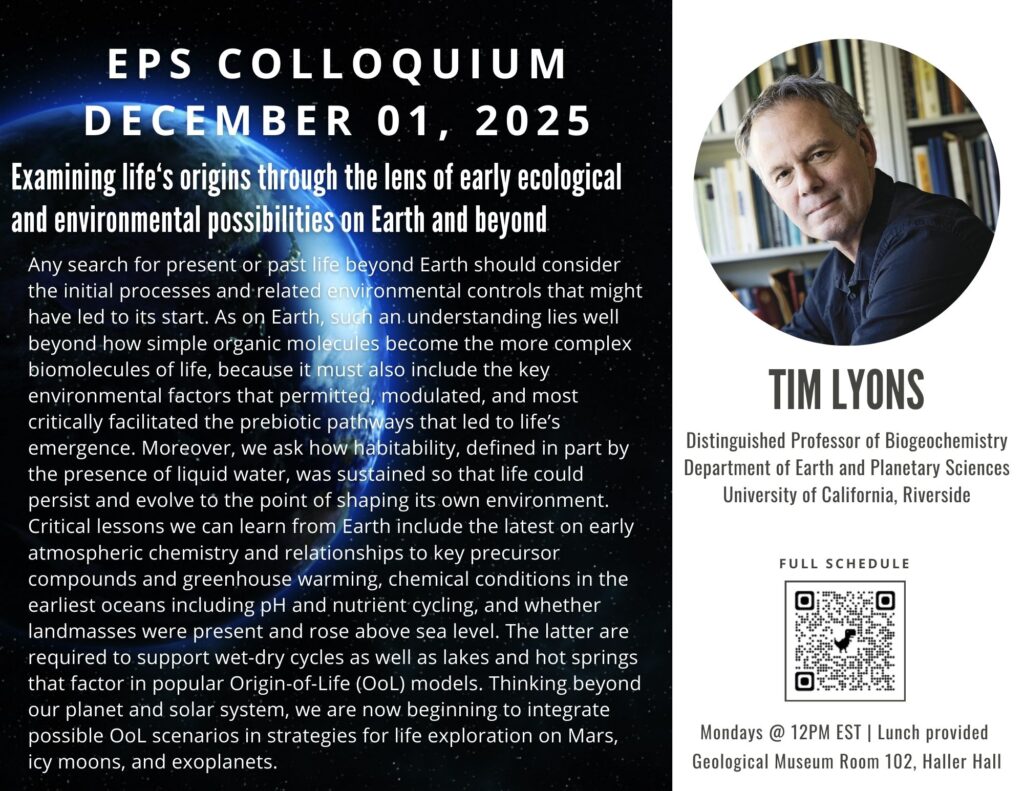
Tim Lyons is a Distinguished Professor of Biogeochemistry in the Department of Earth and Planetary Sciences at University of California-Riverside. He is Director of the UCR Alternative Earths Astrobiology Center and the Wilber W. Mayhew Endowed Chair in Geo-Ecology. Lyons is a geochemist interested in the history of microbial life and its surroundings. He works in the complementary research spheres of astrobiology, ancient oceans and lakes and their modern analogs, geobiology, biogeochemical cycling, isotopic and elemental tracers of ancient environments, and co-evolving early life. Genomic, geologic, and geochemical tools define temporal slices, or ‘alternative Earths,’ that track across the beginnings and subsequent expansion of microbial innovations and ecosystems over billions of years. The related drivers and consequences of first-order environmental change are revealed, along with the paths to sustained habitability and detectable biosignatures. Providing a framework to aid in the search for life on extrasolar planets light-years away is a primary motivator. He emphasizes early oxygenation of the atmosphere and oceans and concomitant impacts on nutrients and bioessential trace metals. As a co-lead of a NASA Research Coordination Network, he is using new understandings of Earth’s earliest surface conditions to constrain plausible prebiotic solutions to life’s precursor steps. At the other end of the timescale, he studies ecosystem challenges and impacts on human health in regions with shrinking terminal lakes and thawing arctic permafrost.