


EPS Colloquium – Victor Tsai, Brown University
The Importance of Fault Network Geometry for Understanding Earthquakes
Geologic evidence suggests that most seismogenic faults exist within a complex network of other faults, but most models assume simple fault geometries. In this talk, I discuss recent work I have led to understand the role of such complex fault network geometry. Simple models of elastic interactions suggest that fault stability as well as earthquake ground motions are affected by misaligned fault networks, and observational evidence supports the importance of these simple models.
To be added to the EPS colloquium mailing list, please contact Caroline Carr at carolinecarr@fas.harvard.edu
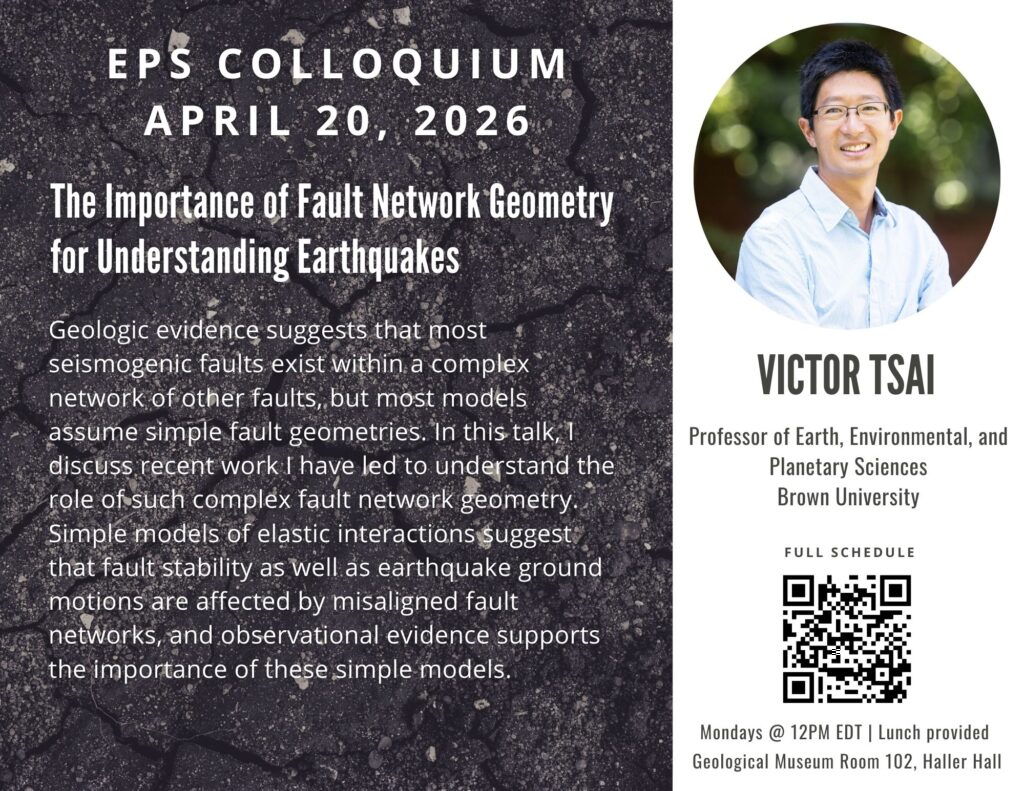
Victor Tsai is a geophysicist with interests in seismology and geomechanics, fluid-solid interactions in Earth systems, theoretical glaciology, and environmental seismology. He has worked on modeling of earthquakes, debris flows, tsunamis, and subglacial hydrology and friction. He also have interest in understanding wave propagation, particularly for ground motion amplification using simplified models and imaging with ambient noise.