


Visiting Speaker: Tyler Kukla, CarbonPlan
This conversation will also have a focus on providing grad students and postdocs an example of applied research in the earth sciences that is aimed at addressing climate change. This is an informal talk open to the EPS and HEB departments. All are welcome. Lunch will be provided.
The carbon removal potential of spreading rocks on fields
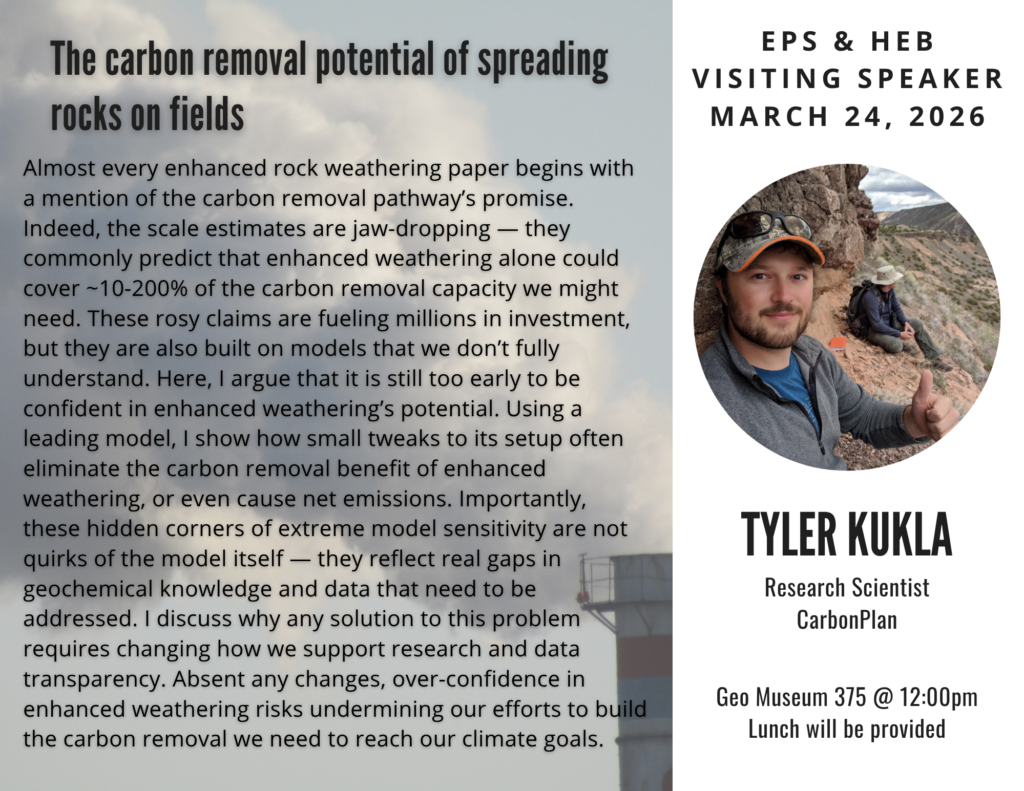
Almost every enhanced rock weathering paper begins with a mention of the carbon removal pathway’s promise. Indeed, the scale estimates are jaw-dropping — they commonly predict that enhanced weathering alone could cover ~10-200% of the carbon removal capacity we might need. These rosy claims are fueling millions in investment, but they are also built on models that we don’t fully understand. Here, I argue that it is still too early to be confident in enhanced weathering’s potential. Using a leading model, I show how small tweaks to its setup often eliminate the carbon removal benefit of enhanced weathering, or even cause net emissions. Importantly, these hidden corners of extreme model sensitivity are not quirks of the model itself — they reflect real gaps in geochemical knowledge and data that need to be addressed. While some of these gaps may be solvable in the near-term, others have already stood for decades. The key implication of these results is that enhanced weathering may be running before it can walk. As this pathway takes off in carbon markets, and as integrated assessment models assign it an ever-larger share of total carbon removal, the appetite for closing knowledge gaps is waning. I discuss why any solution to this problem requires changing how we support research and data transparency. Absent any changes, over-confidence in enhanced weathering risks undermining our efforts to build the carbon removal we need to reach our climate goals.
I am a geochemist and (paleo)climatologist studying the interactions of climate, water, carbon, and life.
I’m a research scientist at CarbonPlan*, and was previously a postdoctoral fellow in the NOAA Climate and Global Change program working in the Ecoclimate Lab at the University of Washington and the Siler Lab at Oregon State.
My work follows two threads: (1) what works and what doesn’t in “open system” Carbon Dioxide Removal (CDR); (2) using the geologic past to form and test theories about Earth system feedbacks.