


EPS Colloquium – Robert Hazen, Carnegie Institute
Mineral Informatics: Discovering Earth’s Deep-Time History
Minerals, the oldest objects you can hold in your hand, tell the epic stories of planets and moons. Every specimen is an information-rich time capsule waiting to reveal its past, with dozens of major and trace chemical elements, scores of isotopes, fluid and solid inclusions, myriad structural and physical prop-erties, and countless other attributes. Thanks to large and growing open-access data resources, coupled with advanced analytical and visualization methods, a new era of mineral informatics has dawned. In-sights emerging from a host of novel multi-dimensional approaches are framing a new approach to mineral classification, the “Evolutionary System of Mineralogy,” which complements the official chemical/structural classification of the International Mineralogical Association. A growing catalog of studies in mineral evolution documents Earth’s changing near-surface mineralogy, with an emphasis on the critical roles of plate tectonics, biological processes, the crystal chemical impact of rare elements, and the dominant effect of water/rock interactions—all critical factors in our planet’s inexorable increase in mineral diversity over more than 4.5 billion years. Taken together, these and other informatics methods are transforming our understanding of planetary evolution through billions of years of change.
To be added to the EPS colloquium mailing list, please contact Caroline Carr at carolinecarr@fas.harvard.edu
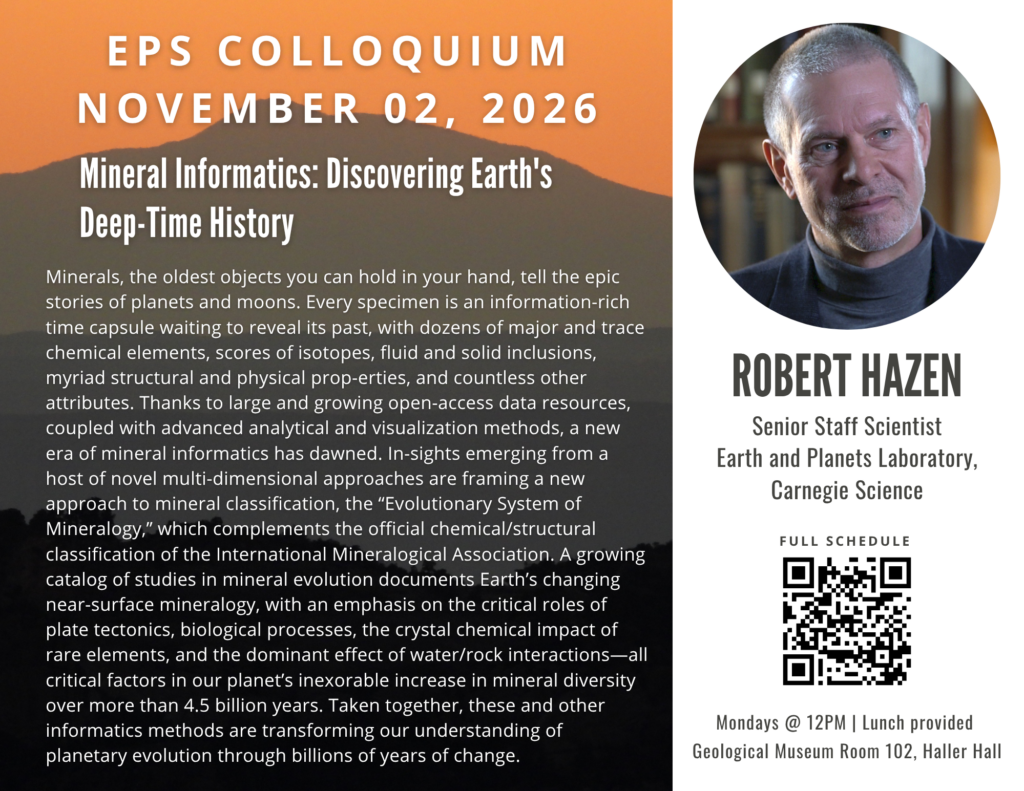
Robert M. Hazen, Staff Scientist at the Earth and Planets Laboratory of Carnegie Science in Washington, DC, and Robinson Professor of Earth Sciences, Emeritus, at George Mason University, received degrees in geology and mineralogy from MIT and Harvard. Author of more than 550 articles and books on science, history, and music, Hazen has been recipient of numerous awards, including the 2025 AGI Legendary Geoscientist Medal, the 2021 IMA Medal, the 2016 Roebling Medal of the Mineralogical Society of America, and the 2012 Virginia Outstanding Faculty Award. He is Fellow of AGU, GSA, AAAS, MSA, ISSOL, the Geochemical Society, and a Foreign Member of the Russian National Academy of Sciences. His book The Story of Earth (Viking-Penguin) was finalist in the Royal Society and Phi Beta Kappa science book competitions. The biomineral “hazenite,” as well as a fossil dolphin and a fossil hermit crab, were named in his honor. Since 2008, Hazen and his colleagues have explored “mineral evolution” and “mineral informatics”—new approaches that exploit large and growing mineral data resources to understand the co-evolution of the geosphere and biosphere.