


EPS Colloquium – Daniel Stolper, UC Berkeley
A new isotopic approach for estimating past humidity using tree cellulose
Atmospheric relative humidity exerts a fundamental control on terrestrial hydroclimate, influencing weather patterns, plant water use, wildfire activity, and ecosystem structure. Given this importance for the modern, a long-standing question in Earth history is how relative humidity has varied in the geologic past under different climate states. One common way that relative humidity is determined for ancient systems is via measurements of the oxygen or hydrogen isotopic composition of sedimentary minerals or organic compounds as proxies for the isotopic composition of ancient terrestrial surface waters including in lakes, soils, and leaves. However, the isotopic compositions of these waters also depend on additional factors including water source, degree of rainout (e.g., continentality and elevation), and temperature. This make standard isotopic approaches for relative humidity reconstructions non-unique. Here I demonstrate that the measurement of all three isotopes of oxygen, 16O, 17O, 18O, termed triple oxygens, of wood cellulose provides a quantitative and theoretically grounded approach for reconstructing growing season relative humidity of terrestrial ecosystems. I will outline the basis for the approach, step through calibrations, and provide an example reconstruction from the last glacial period.
To be added to the EPS colloquium mailing list, please contact Caroline Carr at carolinecarr@fas.harvard.edu
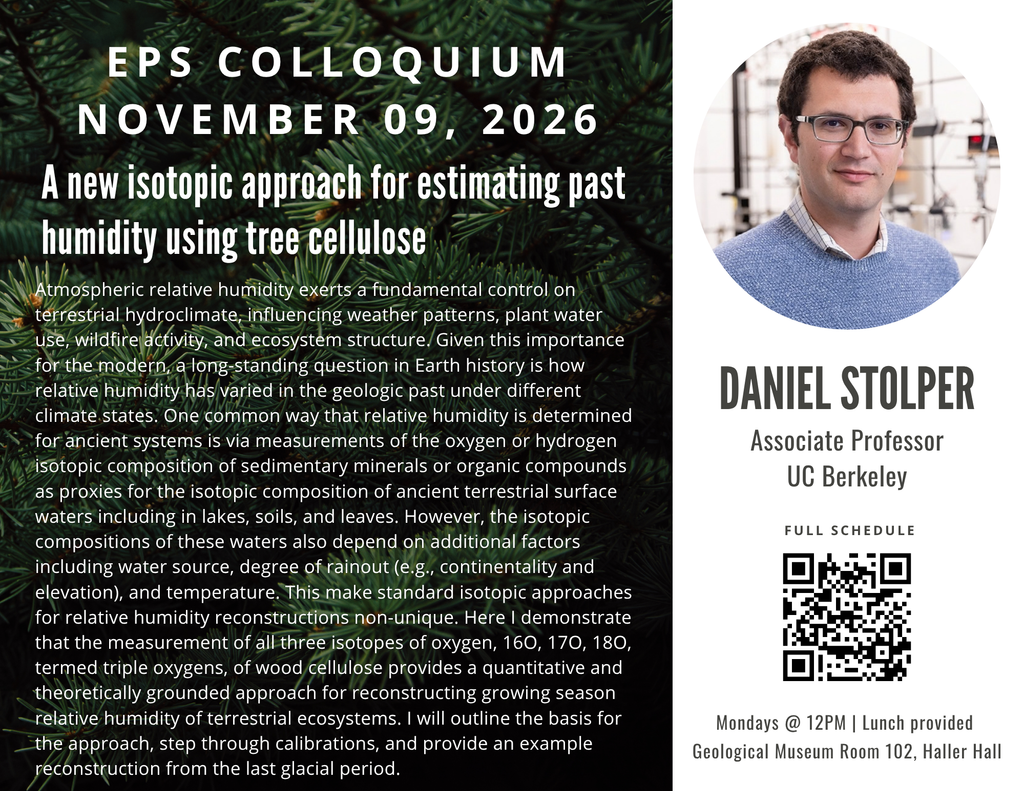
Daniel Stolper is a geochemist with interests in a variety of problems related to the rock record, microbiology, and biogeochemical cycles in the present and past. His approach to scientific problems is centered around linking experiments and physically based models to natural observations in an integrated fashion and, when necessary, developing new methods and techniques. Daniel’s lab is centered around mass spectrometric measurements of experimental and environmental samples. In addition to being a professor at UC Berkeley, he is also a Faculty Scientist in the Earth & Environmental Sciences Area at Lawrence Berkeley National Laboratory.