


EPS Colloquium – Elizabeth Rampe, NASA
Minerals on Mars
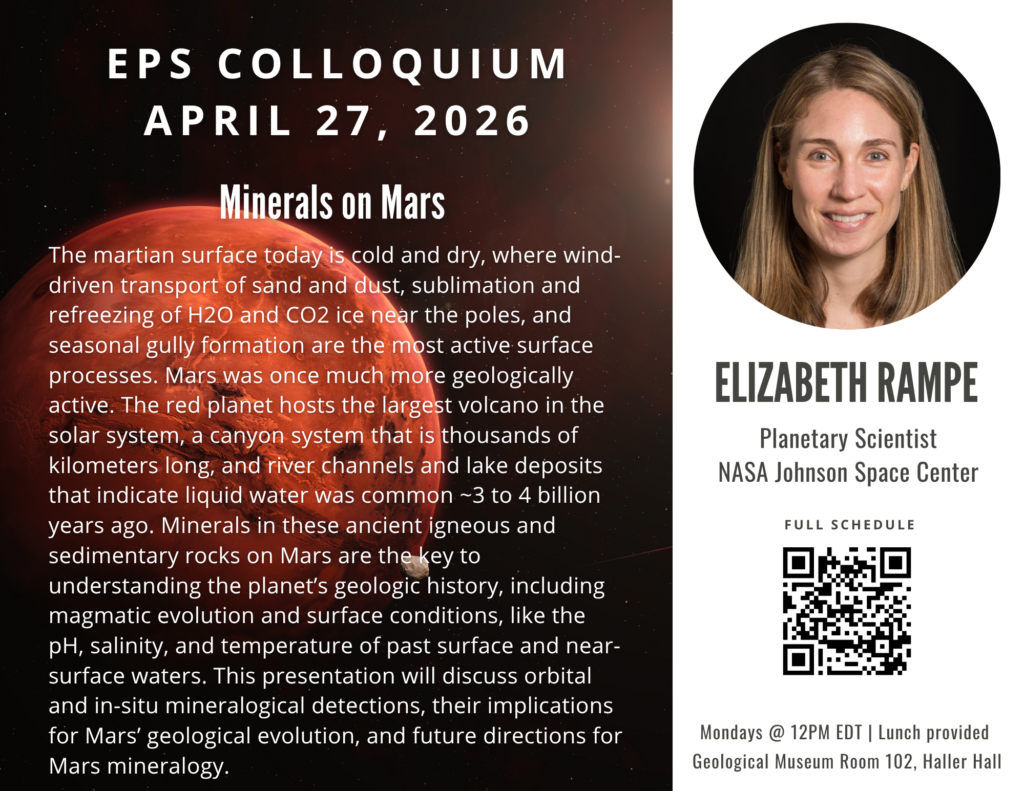
The martian surface today is cold and dry, where wind-driven transport of sand and dust, sublimation and refreezing of H2O and CO2 ice near the poles, and seasonal gully formation are the most active surface processes. Mars was once much more geologically active. The red planet hosts the largest volcano in the solar system, a canyon system that is thousands of kilometers long, and river channels and lake deposits that indicate liquid water was common ~3 to 4 billion years ago. Minerals in these ancient igneous and sedimentary rocks on Mars are the key to understanding the planet’s geologic history, including magmatic evolution and surface conditions, like the pH, salinity, and temperature of past surface and near-surface waters. This presentation will discuss orbital and in-situ mineralogical detections, their implications for Mars’ geological evolution, and future directions for Mars mineralogy.
To be added to the EPS colloquium mailing list, please contact Caroline Carr at carolinecarr@fas.harvard.edu
Dr. Elizabeth (Liz) Rampe is a planetary scientist in the Astromaterials Research and Exploration Science Division at the NASA Johnson Space Center (JSC). She got her B.A. in geology from Colgate University, her Ph.D. in geology from Arizona State University, and was a NASA Postdoctoral Program Fellow at JSC. Liz is the Deputy Principal Investigator of the CheMin X-ray diffractometer and X-ray fluorescence spectrometer on the Mars Science Laboratory Curiosity rover. She has participated in multiple NASA advisory panels related to Mars Sample Return and future missions to Mars, received the NASA Exceptional Scientific Achievement Medal in 2022 for her work on CheMin, and was awarded the Mineralogical Society of America Dana Medal in 2025 for sustained outstanding scientific contributions through original research in the mineralogical sciences.