


EPS Colloquium – Gregory Beroza, Stanford University
Insights into Magmatic Unrest from Deep-Learning-Based Earthquake Monitoring
We have developed deep-learning-based models for tasks involved in seismic monitoring to develop far more comprehensive catalogs of activity than were previously possible, and have applied them to multiple magmatic systems in diverse settings. In Mayotte they revealed far more long-period events than were previously known. In Campi Flegrei they revealed activity of limited depth extent on the ring fault, and the existence of multiple previously unrecognized faults under the western suburbs of Naples. In the Santorini-Amorgos Arc they revealed multiple episodes of rapid horizontal and gradual vertical migration. In each of these cases, the insights we developed inform hazard assessment. For Mayotte, ongoing activity at depth suggests that the magmatic system remains active. In Campi Flegrei, the lack of events below 4 km depth suggests that there is no immediate threat of an eruption due to magma transfer from the deeper reservoir. In the Santorini-Amorgos Arc the lack of events shallower than 8 km suggests dike injection did not approach the surface during the February 2025 crisis. The combination of the isolated nature of volcano monitoring in local observatories and the limited deployment of deep learning for seismic monitoring, points to an unmet need for a federated approach to dealing with the threat of eruptions in future volcanic crises.
To be added to the EPS colloquium mailing list, please contact Caroline Carr at carolinecarr@fas.harvard.edu
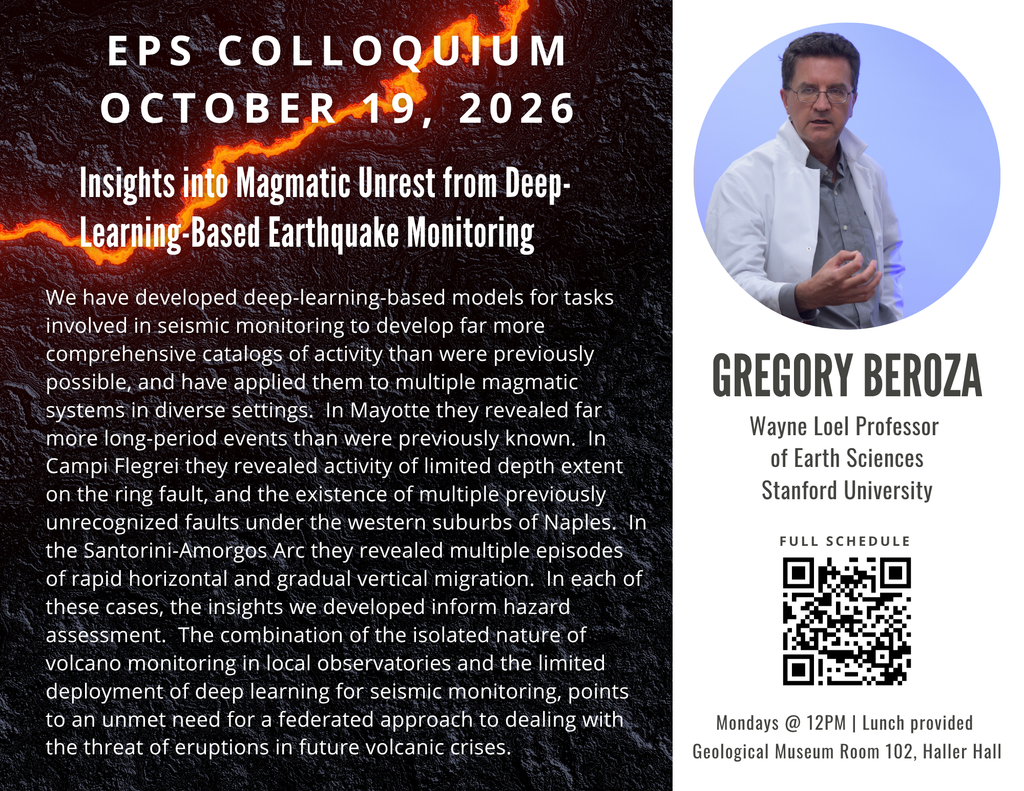
Greg Beroza is a seismologist known for his work on earthquake processes. He is known particularly for his studies of the systematics and mechanics of slow, intermediate-depth, and induced earthquakes that have contributed to understanding those phenomena and quantifying the hazards they pose. Beroza was born in Los Angeles, California, and grew up there, and in Phoenix, Arizona. He graduated from the University of California, Santa Cruz with a B.S. in Geophysics and then from the Massachusetts Institute of Technology with a Ph.D. in Geophysics in 1989. After a one-year postdoctoral position at MIT, he joined the faculty in the Department of Geophysics at Stanford University in 1990 where he now holds the Wayne Loel Professorship. He has been Deputy Director, then Co-Director, of the Southern California Earthquake Center since 2007. He was named an NSF Presidential Young Investigator, a Fellow of the AGU in 2008, the Beno Gutenberg Medal of the European Geosciences Union in 2014, and a member of the National Academy of Sciences in 2022.