


EPS Colloquium – Shannon Curry, UC Boulder
Observational strategies for atmospheric escape in the Solar System
What observational strategies maximize our knowledge of the physics of atmospheric escape in the Solar System?
A critical aspect of understanding habitability beyond Earth is the evolution of a planetary atmosphere. Atmospheres dictate the surface pressure that ultimately determines whether water or other hydrocarbons can exist in a stable liquid form. Liquids are especially effective at transporting nutrients and other integral compounds (such as oxygen), which the evolution of life on Earth has depended on. Orbiters and landers at our terrestrial neighbors, Mars and Venus, have yielded the most observations of atmospheric escape. Analysis of these observations illuminates the physics of atmospheric escape, which we can apply to planets and moons throughout the universe. What is particularly fascinating about the atmospheres of Mars and Venus is that they represent two extremes in evolution; Mars’ surface pressure is ~7 mbars while that of Venus reaches almost 90 bars, both in stark comparison to Earth’s normalized 1 bar of surface pressure. How two planets that formed at similar times as the Earth can have such dramatically different paths inherently requires an interdisciplinary approach. This talk will focus on different observational strategies for different types of atmospheres and bodies. I will discuss some of the key factors that influence a planetary atmosphere, including volcanism and outgassing, as well as the processes and physics of atmospheric escape, which rely heavily on the interaction with the host star. Additionally, I will discuss past, present and future missions studying atmospheric escape in our own solar system.
To be added to the EPS colloquium mailing list, please contact Caroline Carr at carolinecarr@fas.harvard.edu
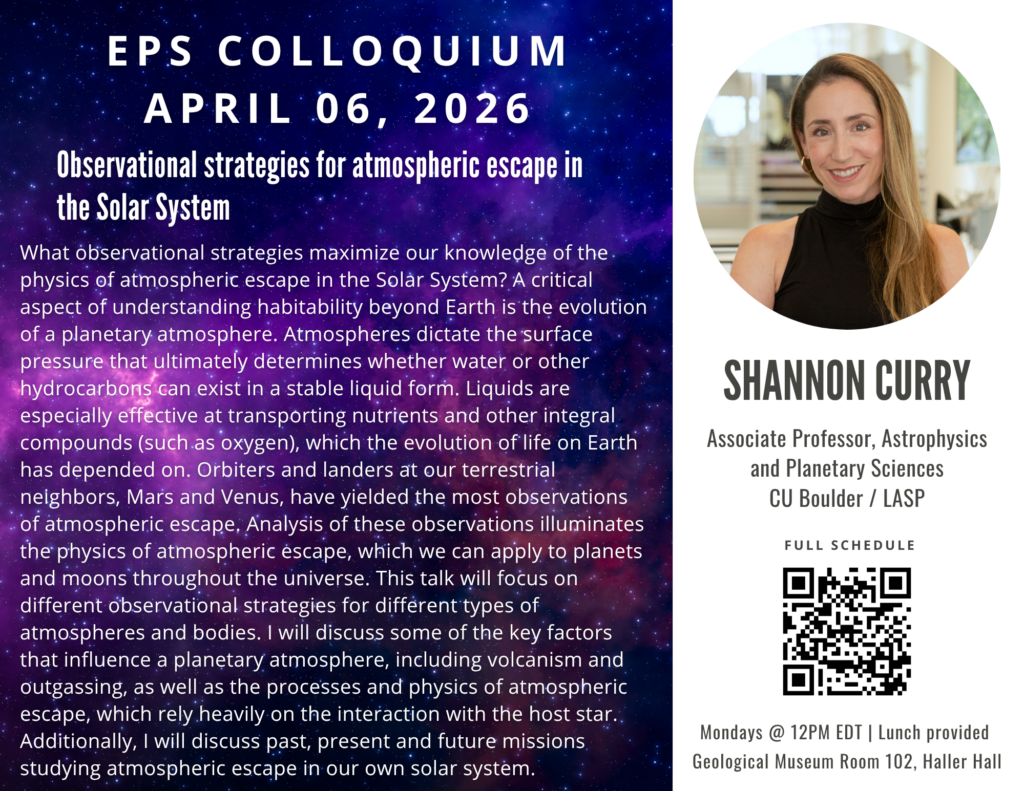
Dr. Curry is the Principal Investigator of the Mars Atmospheric and Volatiles EvolutioN (MAVEN) mission and an Associate Professor in the Astrophysics and Planetary Sciences (APS) Department at the University of Colorado, Boulder. Her research focuses on how planets and their atmospheres are influenced by the sun and solar activity and she specializes in planetary missions and operations. Dr. Curry is also the Project Scientist for NASA’s ESCAPADE mission and a science team member on Parker Solar Probe (PSP) mission. She previously served as a member and chair for NASA’s Planetary Advisory Committee (PAC). She received her B.S. in Astrophysics from Tufts University and her Ph.D. from the University of Michigan.