


EPS Colloquium – Ali Sarhadi, Georgia Tech
Compound Hurricane Hazards in a Warming Climate: Physics and AI for Resilience
Hurricanes pose compounding threats to coastal communities through interacting hazards—torrential rainfall, storm surge, inland flooding, and wind—that together create far greater impacts than any single hazard alone. Traditional risk assessments based on historical data and isolated hazard models cannot adequately capture future risk as our climate changes and sea levels rise. In this talk, I present an integrated framework that combines physics-based hurricane and hydrodynamic modeling with machine learning to simulate compound flooding and wind damage, and to assess the economic risk in coastal cities. I demonstrate how climate change and sea-level rise nonlinearly amplify both flood hazards and economic losses in the coming decades, revealing critical thresholds for resilience planning. I then introduce a generative AI approach that forecasts compound flooding days before hurricanes make landfall using predicted storm tracks. By training AI emulators on synthetic storm scenarios, we deliver rapid, accurate predictions that support timely decisions to protect lives, infrastructure, and communities.
To be added to the EPS colloquium mailing list, please contact Caroline Carr at carolinecarr@fas.harvard.edu
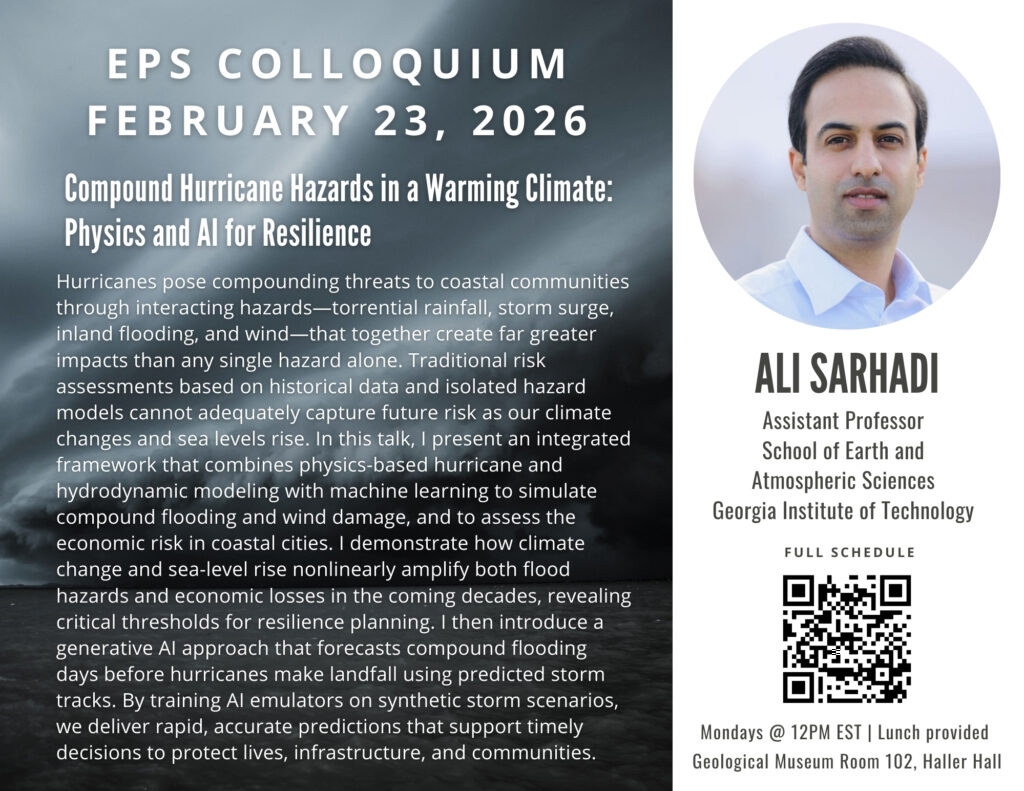
Ali Sarhadi is an Assistant Professor in the School of Earth and Atmospheric Sciences at the Georgia Institute of Technology, where he leads the Climate Risk & Extremes Dynamics Lab. His research focuses on tropical cyclones and climate extremes, investigating their risks and impacts on coastal cities, infrastructure, and communities in a warming climate through physics-based simulations and ML/AI modeling. His work emphasizes compound and cascading risk assessment, uncertainty quantification, early warning systems, climate adaptation, and resilient infrastructure design using engineering and nature-based solutions. He holds a Ph.D. in Civil and Environmental Engineering from the University of Waterloo and completed postdoctoral research at Stanford University and MIT.