


EPS Colloquium – Yuan Wang, Stanford University
From Microphysics to Climate: Understanding Clouds and Aerosols across Scales
Clouds and aerosols are central regulators of Earth’s energy balance, hydrological cycle, and atmospheric chemistry, yet their interactions remain among the largest sources of uncertainty in weather and climate prediction. These processes originate at the microphysical scale, but their impacts propagate across convective, regional, and global scales through complex dynamical feedbacks. Bridging this scale gap is therefore essential to developing a more complete and predictive understanding of the climate system. In this talk, I will present our recent efforts to: 1) develop an AI/ML-based cloud microphysics scheme to represent warm-rain formation in climate models; 2) improve the representation of aerosol–cloud interactions in the cloud-resolving and fire-coupled simulations of pyroCb, a wildfire-induced deep convective system. Our multi-task encoder-decoder machine learning framework based on coarse-grained large-eddy simulations reduces the marine stratocumulus mean liquid water path bias against DOE/ARM observations and uniquely maintains a physical aerosol first indirect effect while original bulk schemes weaken or reverse its trend. Our improved WRF-Chem-SFIRE model shows biomass-burning aerosols strengthen convective updrafts, weaken downdrafts, and increase convective areas, resulting in more efficient smoke injection into the upper troposphere and lower stratosphere. Taken together, our findings highlight the need for multiscale modeling tools and richer process-level atmospheric observations to advance a mechanistic understanding of clouds and aerosols in a fully coupled Earth system context.
To be added to the EPS colloquium mailing list, please contact Caroline Carr at carolinecarr@fas.harvard.edu
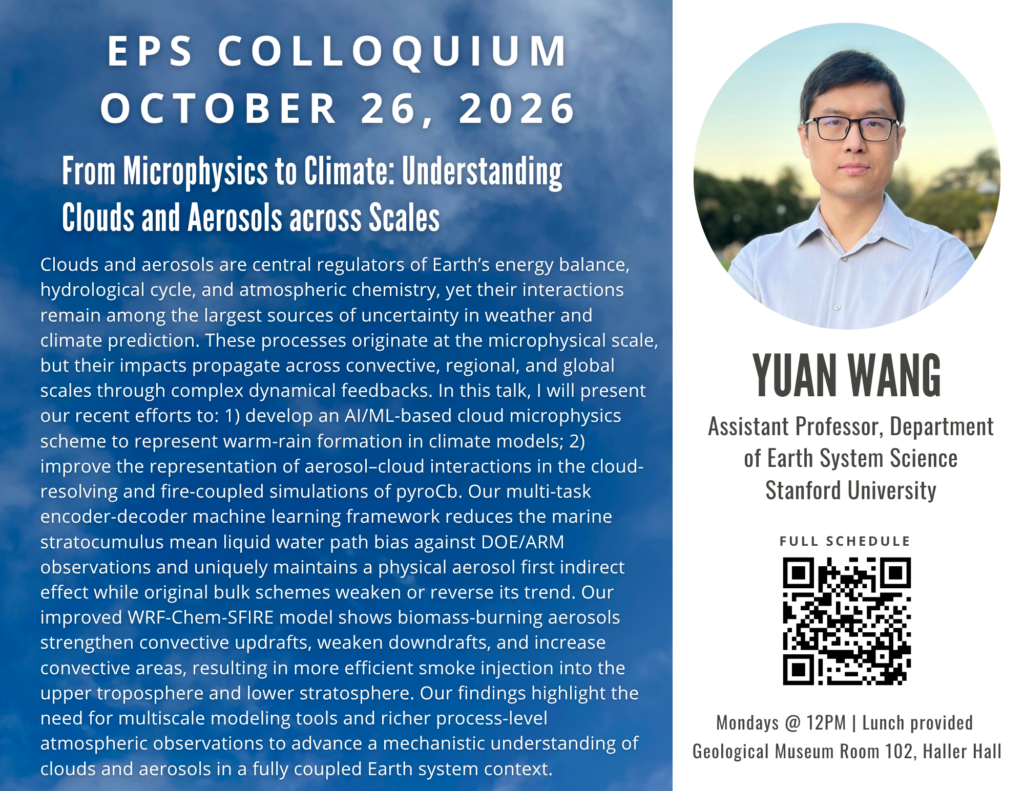
Dr. Yuan Wang is an assistant professor of Earth System Science and a center fellow in the Woods Institute for the Environment at Stanford University. Yuan got his Ph.D. degree in Atmospheric Sciences from Texas A&M University. He and his group conduct research related to aerosol-cloud-precipitation interactions and their climatic implications, aerosol properties and haze formation, cloud microphysics and dynamics, and the assessment of the greenhouse gas/aerosol forcings in the Earth’s system. To address those scientific questions, his group develop and employ multiscale weather and climate models and machine learning approaches in combination with space-borne and in situ measurements. Yuan was awarded the AGU James Macelwane Medal and James Holton Award, the AMS Henry Houghton Award, and the NSF CAREER Award. Currently, Yuan serves as an inaugural Editor-in-Chief of npj Clean Air and an Editor of Atmospheric Chemistry and Physics.